
Gilsonite, also known as natural bitumen or natural asphalt, is a high-performance hydrocarbon resin that has been a staple in the oil and gas industry for over 60 years.
Found naturally as a solid mineral (Uintaite), it offers a unique combination of chemical properties that synthetic additives struggle to replicate.
Major industry leaders like SLB and Halliburton rely on Gilsonite to ensure wellbore stability and integrity in the world’s most challenging environments.
Why Gilsonite is Critical for Oil & Gas Operations
Gilsonite is the only multifunctional additive that can simultaneously perform multiple tasks, such as controlling fluid loss and stabilizing troublesome geological formations.
Key Technical :
High Thermal Stability: It remains effective at temperatures up to 400°F (204°C).
Cost Efficiency: Using Gilsonite can lead to cost savings of more than 80% compared to using multiple synthetic alternatives.
Multifunctional: It serves as a bridging agent, lubricant, and sealer all at once.
1. Gilsonite in Drilling Fluids
Drilling fluids (or mud) are essential for cooling the drill bit and carrying rock cuttings to the surface.
Gilsonite is a standard ingredient in oil-based, water-based, and synthetic-based mud systems
How it Enhances Drilling:
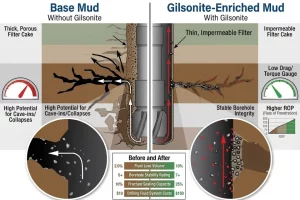
Shale Stabilization: It physically seals micro-fractures in water-sensitive shales, preventing hole collapse and saving costly drilling time.
Fluid Loss Control (FLC): Gilsonite reduces High-Temperature High-Pressure (HTHP) fluid loss by 45–55%, creating a more stable environment for drilling.
Lubricity: It reduces friction between the drill string and the borehole, which is especially vital in high-deviation or horizontal wells.
Preventing Stuck Pipe: By sealing off permeable formations, it prevents differential sticking, a common and expensive problem where the drill pipe becomes stuck against the well wall.
|
Property
|
Base Mud (WBM)
|
Base + 3% Gilsonite
|
Improvement
|
|---|---|---|---|
|
HPHT Fluid Loss (300°F)
|
19.2 ml
|
14.4 ml
|
25% Reduction
|
|
Lubricity Coefficient
|
0.291
|
0.237
|
19% Improvement
|
|
Shale Recovery
|
87.5%
|
89.0%
|
Better Stability
|
2. Gilsonite in Oil Well Cementing
In cementing, Gilsonite is used to ensure the long-term integrity of the wellbore and to isolate different geological zones.
Key Functions in Cementing:
Density Reduction: Gilsonite has a low specific gravity (1.04–1.10), allowing it to reduce cement slurry weight down to 11.5 ppg without losing compressive strength.
Lost Circulation Control:
The irregularly shaped particles bridge and plug fractures in weak formations, ensuring the cement stays where it is needed.
Gas Migration Prevention:
It has a unique gas activated sealing property, exposure to natural gas actually makes Gilsonite enriched cement less permeable, preventing dangerous gas leaks.
|
Grade
|
Particle Size
|
Best Use Case
|
|---|---|---|
|
Coarse
|
4–50 mesh
|
Maximum cement strength
|
|
Medium
|
50–100 mesh
|
Balance of strength and density reduction
|
|
Fine
|
<50 mesh
|
Lightest weight and lowest permeability
|
3. Gilsonite vs. Coal: What’s the Difference?
|
Property
|
Gilsonite (Natural Asphalt)
|
Coal
|
|---|---|---|
|
Chemical Nature
|
Hydrocarbon
|
Carbon
|
|
Softening Point
|
150–250°C
|
Starts above 300°C
|
|
Thermal Sealing
|
Softens and seals at well temperature
|
Does not soften
|
|
Cementing Strength
|
Maintained/Improved
|
Often reduced
|